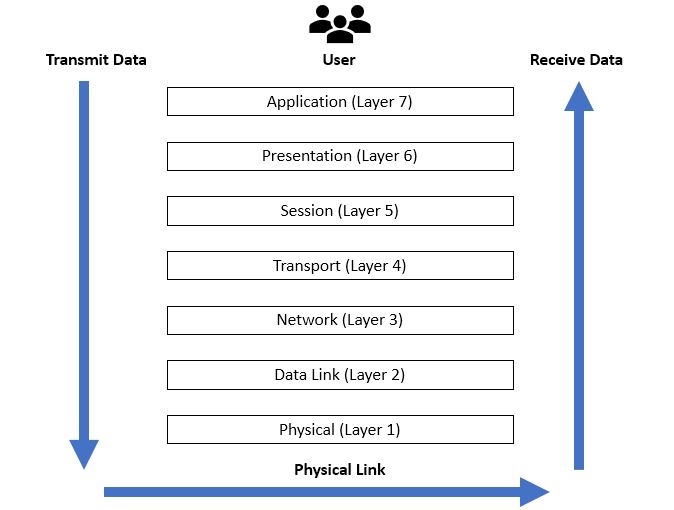
OSI Model
Application Layer
- Closest to end user and Interacts with software applications, for example web browsers like Chrome etc.,
- HTTP and HTTPS are layer 7 protocols.
- Functions include identifying communication partners and synchronizing communication.
Presentation Layer
- To translate between application and network formats.
- For example, encryption of data as it is sent and decryption of data as it is received.
- Also translates between different application layer formats. In conclusion, it's job is to ensure data is in a appropriate format that receiving host can understand.
Session Layer
- Controls dialogues (sessions) between communication hosts.
- Establishes, Manages and terminates connection between local apps (like web browsers) and remote applications (like Youtube).
Transport Layer
- Segments and reassembles data for communication between end hosts.
- It breaks the large pieces of data into smaller segments which can be more easily transmitted without Tx problems when errors occur.
- Provides "Host to Host (End to end)" communication. Also provides "Process to Process" communication for Applications.
- When large data is segmented into small segments, each segment is added a "layer 4 header" and send to layer 3 (Network Layer) and "layer 3 header" is added on.
Network Layer
- Logical Addressing: The network layer uses logical addresses (e.g., IP addresses) to uniquely identify devices on a network. These addresses are assigned hierarchically, allowing for efficient routing of data across interconnected networks.
- Routing: Routing is a crucial function of the network layer. It involves determining the optimal path for data packets to travel from the source to the destination across multiple networks. Routing algorithms are used to make these decisions based on the logical addresses of the source and destination.
- Packet Forwarding: Once the optimal route is determined through routing, the network layer is responsible for forwarding data packets from one router to the next along the path to the destination. Each router makes forwarding decisions based on the destination address in the packet header.
Data Link Layer
- Frame Encapsulation: The Data Link Layer is responsible for encapsulating data into frames for transmission over the network. Frames include necessary information such as source and destination MAC addresses.
- MAC Address Management: Manages MAC (Media Access Control) addresses, unique hardware addresses assigned to network interfaces, for addressing and delivering frames within the local network segment.
- Error Detection and Flow Control: Implements error detection mechanisms to identify and manage errors during data transmission. It also supports flow control to regulate the flow of data between devices, preventing potential congestion or data loss.
Physical layer
- Bit Transmission:The Physical Layer is responsible for the transmission of individual bits over the physical medium, such as copper wires, fiber optics, or wireless frequencies.
- Signal Encoding: It defines how digital data is encoded into electrical or optical signals suitable for transmission, ensuring compatibility with the chosen physical medium.
- Bit Synchronization:Ensures that the sender and receiver devices are synchronized with the timing of transmitted bits, a crucial aspect for accurate data reception and to prevent timing-related errors.